Tag: Memory

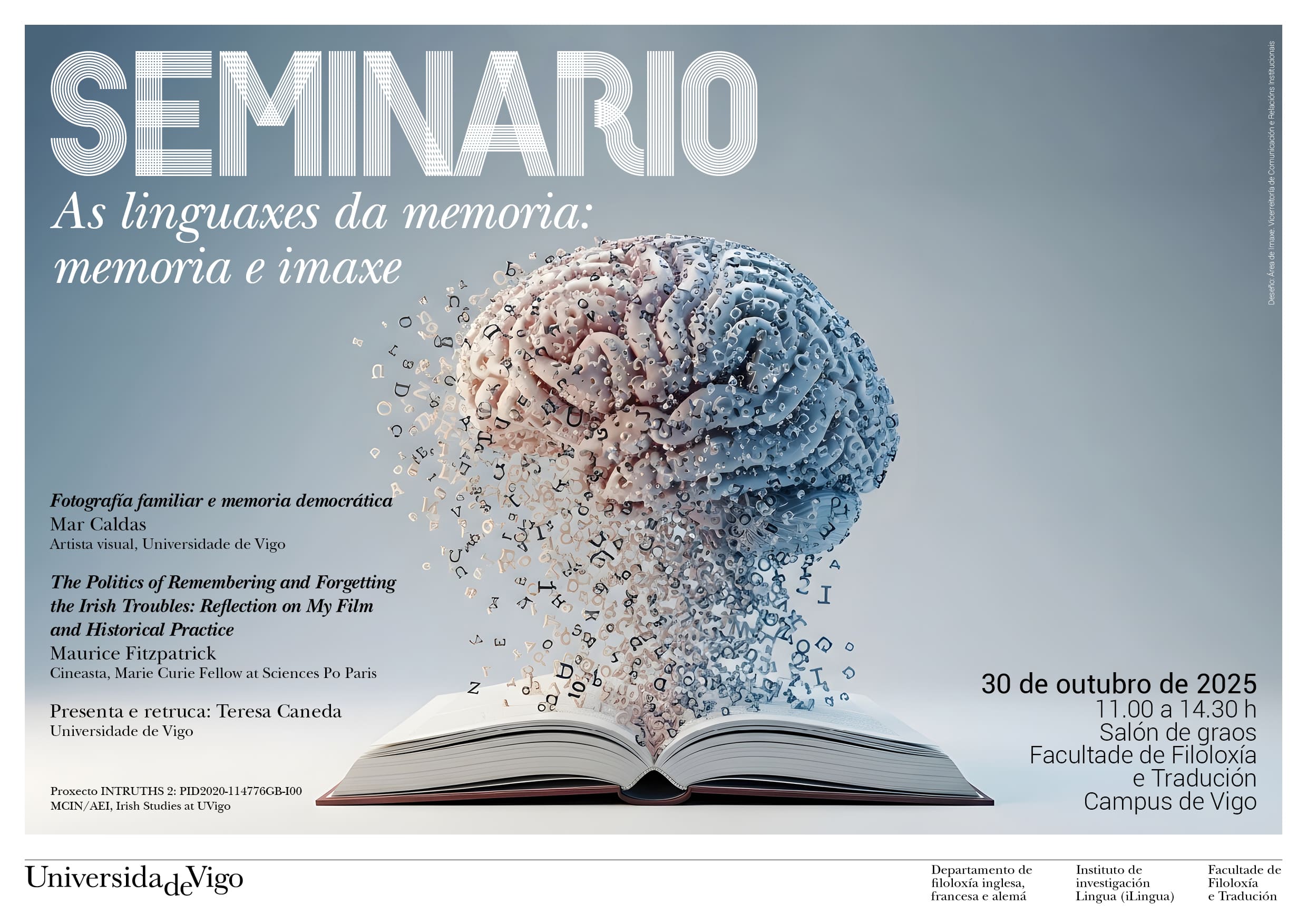
  • The Languages of Memory: Memory and Image with Mar Caldas and Maurice Fitzpatrick. Exploring Visual Culture and Collective Memory

    The Languages of Memory: Memory and Image with Mar Caldas and Maurice Fitzpatrick. Exploring Visual Culture and Collective Memory

    Centred on the image as a site of reflection and meaning, the seminar “The Languages of Memory: Memory and Image”, led by visual artist and lecturer at the Faculty of Fine Arts Mar Caldas, together with BBC filmmaker Maurice Fitzpatrick, explored how a broad spectrum of creative practices can shape, reconstruct, and transmit both personal and collective memory. The event took place on Thursday, October 30, in the Salón de Graos of the Faculty of Philology and Translation, and was organized and moderated by Professor Teresa Caneda (University of Vigo), with the support of the Instituto de Investigación Lingua (iLingua) and the Department of English, French and German.

    In her introduction, Professor Teresa Caneda emphasized that “this seminar marks the beginning of a series devoted to examining the visual and narrative codes through which we express and reconstruct the events that shape our memory.” This idea framed the discussion that followed, as participants engaged deeply with the interconnections between image and memory, reinforcing the seminar’s aim to foster interdisciplinary dialogue between artistic creation and humanistic research.

    During the meeting, Mar Caldas shared her experience using visual art as a means of preserving and transmitting family memory. Maurice Fitzpatrick, for his part, discussed the capacity of documentary film to reconstruct historical and collective memory, illustrating how his works interweave personal narratives with broader social contexts. The interventions of both speakers complemented each other, offering a plural and reflective perspective on how images, across different media, articulate stories of the past and contribute to the construction of a people’s memory.

    The success of the initiative, reflected in the large attendance and participatory discussion, highlighted the academic and cultural significance of the seminar. By combining perspectives from visual arts and cinema with critical reflection from the university sphere, “The Languages of Memory: Memory and Image” demonstrated the impact of visual storytelling in shaping collective memory and underscored the value of interdisciplinary initiatives that invite society to rethink its own history through images.
  • inTRUTHS Project funding (2018-2020)

    inTRUTHS Project funding (2018-2020)

    The research project “Inconvenient Truths" has been granted funding (39.930 €) by Spain's Ministry of Economy, Industry and Competitiveness (code FFI2017-84619-P).   The Project's Principal Investigator is Teresa Caneda Cabrera  (P.I. of NETEC), and José Carregal Romero is one of the team members. The project's academic activities and results will feature prominently in the NETEC webpage through the new tab  INTRUTHS 

  • Between Trauma and Desire: Translating the Memory of Migration

    Between Trauma and Desire: Translating the Memory of Migration

    • Prof. Loredana Polezzi, Cardiff University
    • November 30 2017 (Thursday), 11 am.
    • Salón de Actos FFT   > con interpretación simultánea 
    • Organized by: Dpto. FIFA & iDAES

    This lecture is funded by the Departamento de Filoloxía Inglesa, Francesa e Alemá and the Interuniversity Doctoral Programme in Advanced English Studies (iDAES) of the University of Vigo and is directly linked to the seminar (curso de formación) “The Representation of Conflicts: An Introduction to Trauma and Memory in Texts”, co-taught by Teresa Caneda and Martín Urdiales. This seminar approaches the representation of traumatic events such as the Irish Famine and the Holocaust which implied forms of enforced mobility and have become associated with cultural memory/ies. The seminar will focus on texts  which deal with the representation of scenarios of conflict (dislocation, violent assimilation) and  where the relationships among languages and speakers are marked by hierarchies of power.

    In recent years a number of scholars have pointed out that memory needs to be understood as a transnational phenomenon (Erll, 2009; De Cesari and Rigney, 2014). In this lecture, Prof. Polezzi will examine the link between a specific kind of transnational memory –the memory of migration– and processes of linguistic as well as cultural translation. Prof. Polezzi will talk about the way in which the memory of migration is passed on and represented across generations through forms of writing and visual representation which are deeply informed by practices of translation.  She will concentrate on women writers/visual artists/performers in the context of migration and will discuss  how they treat migration and its memory both in relation to trauma and desire.

    Loredana Polezzi is Professor in Translation Studies at the School of Modern Languages at Cardiff University. Her main research interests are translation studies, comparative literature, and the history of travel and migration. Her recent work focuses on how geographical and social mobilities are connected to the theories and practices of translation and self-translation. With Rita Wilson,  she is co-editor of The Translator, a leading international journal in Translation Studies. She is also a co-investigator in the research project “Transnationalizing Modern Languages”, funded by the AHRC’s Translating Cultures scheme, as well as a founding member of the “Cultural Literacy in Europe” network.