Tag: Translation

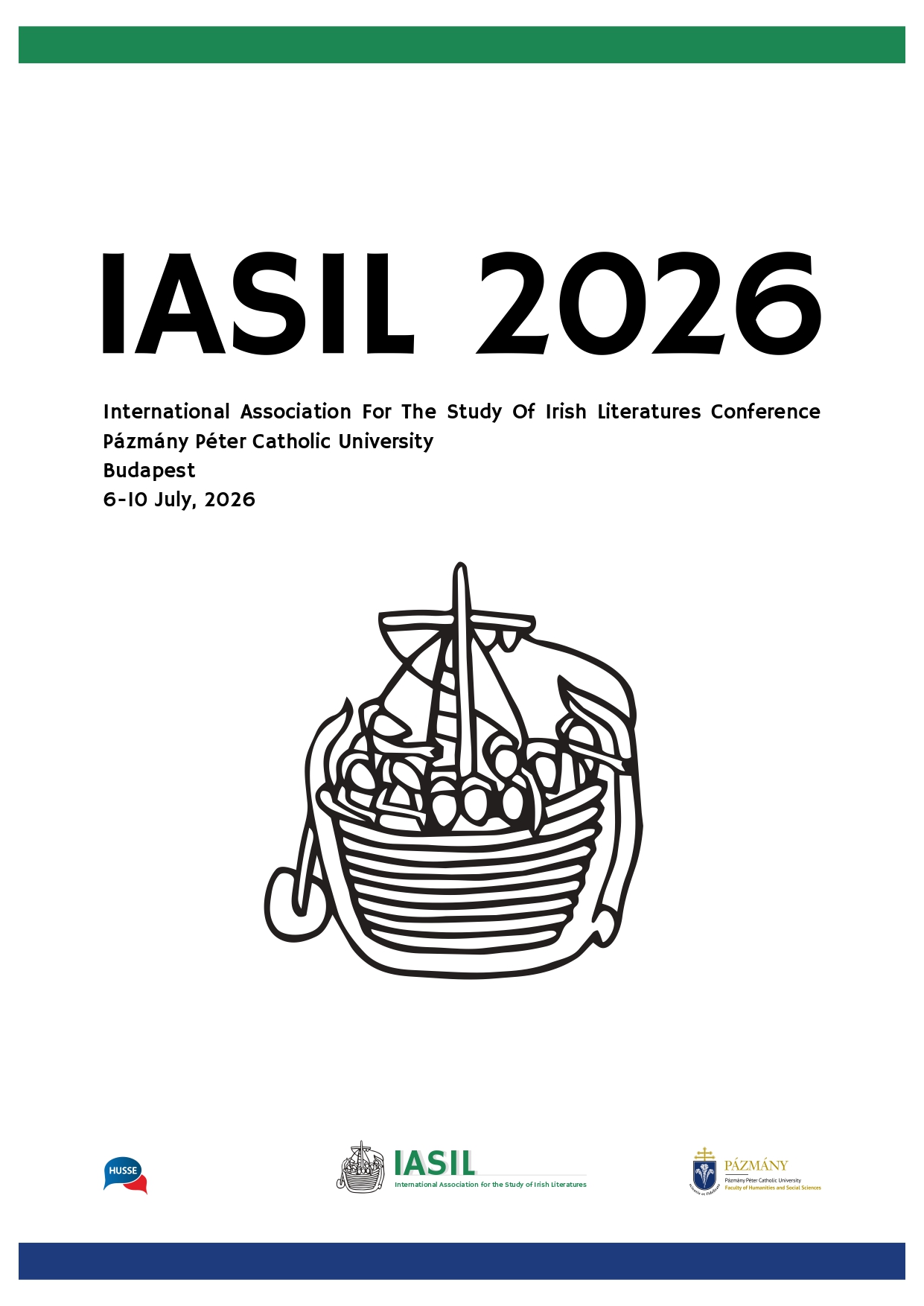
  • IASIL BUDAPEST 2026, PÁZMÁNY PÉTER CATHOLIC UNIVERSITY (PPCU), BUDAPEST 6-10 JULY 2026

    IASIL BUDAPEST 2026, PÁZMÁNY PÉTER CATHOLIC UNIVERSITY (PPCU), BUDAPEST 6-10 JULY 2026

    NETEC research was represented at the IASIL International Conference "Translating Ireland" held at the Pázmány Péter Catholic University (PPCU) from 6 to 10 July 2026. See full programme here 

    José Carregal-Romero contributed to the panel "Sally Rooney" with a paper entitled “Interpreting Contemporary Ireland: Care and Intimacy in Sally Rooney's Intermezzo"

    Lydia Freire contributed to the panel "Translating Ireland in the Eighteenth and Early-nineteenth Century" with a paper entitled "Translating the Hamlet: Ecofeminsit Localities and Matilda's Body-Land in Regina Maria Roche's The Maid of the Hamlet”

  • “Joyce Without Borders”  June 12-16 2018, Mexico City.

    “Joyce Without Borders” June 12-16 2018, Mexico City.

    NETEC  P.I. Teresa Caneda-Cabrera is chairing panel  4.3.Translating Joyce , at the Joyce Without Borders Symposium being held at UNAM's Casa Universitaria del Libro in Mexico City, where she is also presenting a paper entitled "Paradoxical Entanglements: James Joyce and World Literature".This panel is scheduled for Friday 14th 2018, at 9 am. 

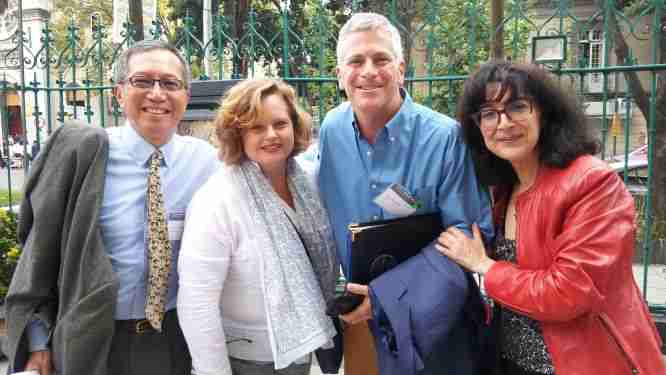
    In the picture Vincent J Cheng, Maria McGarrity, Greg Winston and Teresa Caneda

    See the conference program here  


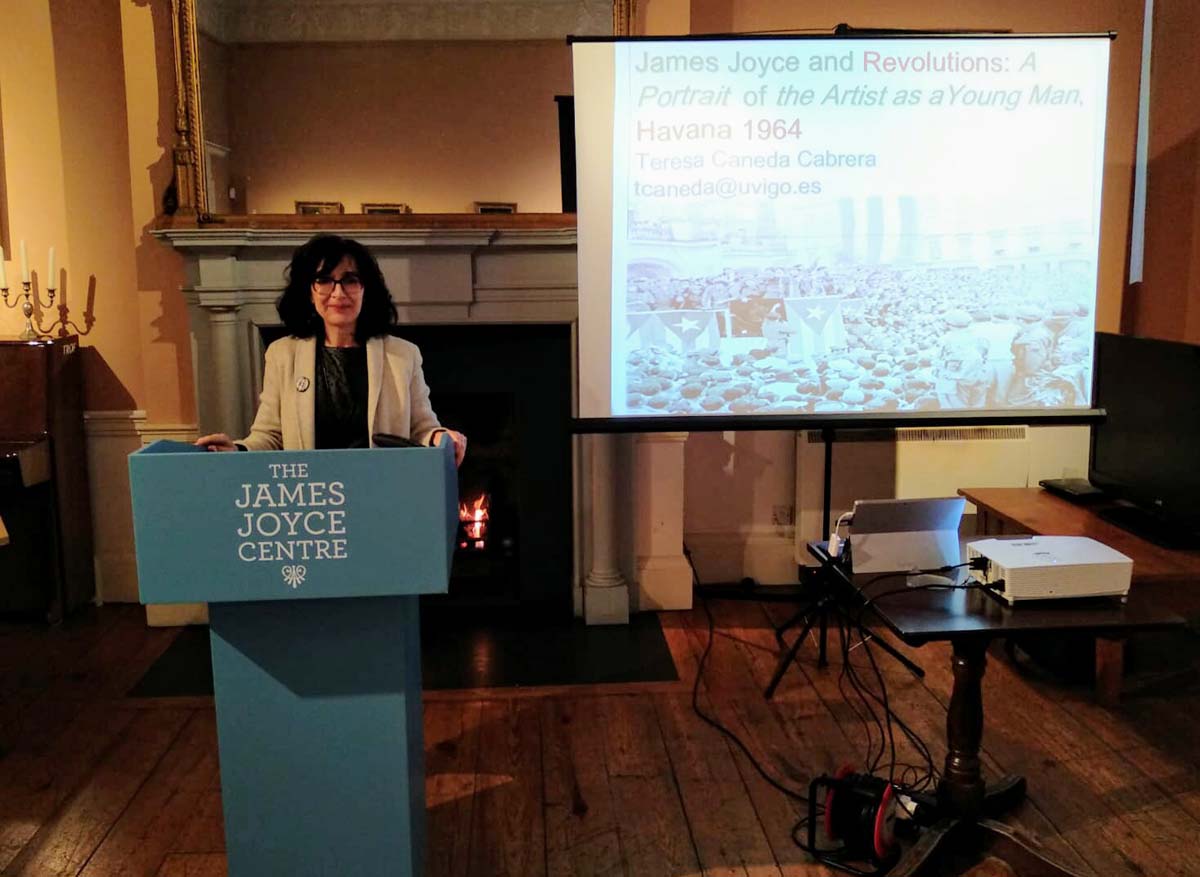
  • James Joyce and Revolutions: A Portrait of the Artist as a Young Man, Havana 1964

    James Joyce and Revolutions: A Portrait of the Artist as a Young Man, Havana 1964


    April 15 2019, 6.30 pm

    The James Joyce Centre was delighted to welcome Dr. Teresa Caneda Cabrera, during her sabbatical as a visiting associate professor at UCD School of English, Drama and Film,  for the April instalment in the Spring / Summer 2019 Lecture series. Dr. Caneda Cabrera's talk focused on the relevance of the 1964 Cuban translation of Joyce’s novel A Portrait of the Artist as a Young Man in the years following the 1959 Cuban revolution.

    Read More…

  • TRANSLATION AND “WORLD LITERATURE”  AT THE CENTRE FOR TRANSLATION AND INTERPRETING OF QUB

    TRANSLATION AND “WORLD LITERATURE” AT THE CENTRE FOR TRANSLATION AND INTERPRETING OF QUB

    NETEC  PI, Teresa Caneda Cabrera, was a guest speaker in the SEMINAR SERIES  of the CENTRE for TRANSLATION AND INTERPRETING at QUEEN'S UNIVERSITY BELFAST on February 25 2019 with the lecture TRANSLATION AND "WORLD LITERATURE". The lecture placed translation at the center of the approaches to the study of the modes of circulation and reading of (world) literature and argued that since literary translators become agents who often activate complex discourses of historical/cultura/political affiliation they necessarily produce different versions and interpretations through which ‘universal’ literary texts and authors exist in a fluid space of global connectedness where confluences arise and yet, simultaneously, meaningful asymmetries are revealed.

  • Between Trauma and Desire: Translating the Memory of Migration

    Between Trauma and Desire: Translating the Memory of Migration

    • Prof. Loredana Polezzi, Cardiff University
    • November 30 2017 (Thursday), 11 am.
    • Salón de Actos FFT   > con interpretación simultánea 
    • Organized by: Dpto. FIFA & iDAES

    This lecture is funded by the Departamento de Filoloxía Inglesa, Francesa e Alemá and the Interuniversity Doctoral Programme in Advanced English Studies (iDAES) of the University of Vigo and is directly linked to the seminar (curso de formación) “The Representation of Conflicts: An Introduction to Trauma and Memory in Texts”, co-taught by Teresa Caneda and Martín Urdiales. This seminar approaches the representation of traumatic events such as the Irish Famine and the Holocaust which implied forms of enforced mobility and have become associated with cultural memory/ies. The seminar will focus on texts  which deal with the representation of scenarios of conflict (dislocation, violent assimilation) and  where the relationships among languages and speakers are marked by hierarchies of power.

    In recent years a number of scholars have pointed out that memory needs to be understood as a transnational phenomenon (Erll, 2009; De Cesari and Rigney, 2014). In this lecture, Prof. Polezzi will examine the link between a specific kind of transnational memory –the memory of migration– and processes of linguistic as well as cultural translation. Prof. Polezzi will talk about the way in which the memory of migration is passed on and represented across generations through forms of writing and visual representation which are deeply informed by practices of translation.  She will concentrate on women writers/visual artists/performers in the context of migration and will discuss  how they treat migration and its memory both in relation to trauma and desire.

    Loredana Polezzi is Professor in Translation Studies at the School of Modern Languages at Cardiff University. Her main research interests are translation studies, comparative literature, and the history of travel and migration. Her recent work focuses on how geographical and social mobilities are connected to the theories and practices of translation and self-translation. With Rita Wilson,  she is co-editor of The Translator, a leading international journal in Translation Studies. She is also a co-investigator in the research project “Transnationalizing Modern Languages”, funded by the AHRC’s Translating Cultures scheme, as well as a founding member of the “Cultural Literacy in Europe” network.

  • Traduciendo obsesiones y vacíos: Samuel Beckett en español

    Traduciendo obsesiones y vacíos: Samuel Beckett en español

    • "Traduciendo obsesiones y vacíos: Samuel Beckett en español"
    • Thursday 1 December, 10 am
    • Salón de Actos FFT
    • Jose Francisco Fernández, Universidad de Almería
    • Organized by: NETEC / Facultade de Filoloxía e Tradución

  • The Task of the Translator: Kafka in Icelandic

    The Task of the Translator: Kafka in Icelandic

    • "The Task of the Translator: Kafka in Icelandic"
    • Friday 29 April , 10 am
    • Salón de Actos FFT
    • Ástráður Eysteinsson, Professor of Comparative Literature and Literary Translator, University of Iceland | Háskóli Íslands
    • Organized by: NETEC / Grupo de Investigacion T&P


    Professor Ástráður Eysteinsson graduated with a BA in German and English from the University of Iceland in 1979. He studied literature and translation studies at the University of Warwick in the UK and finished an MA there in 1981.

    In the years 1980-82 he was a student of German, English and Scandinavian studies at University of Cologne in West-Germany, before moving to the USA in 1982 where he took up doctoral studies at the University of Iowa alongside teaching there. He finished his PhD in 1987.

    During his years of study abroad Eysteinsson started translating literature into Icelandic. He has been active in that field ever since – he has for example translated Franz Kafka’s oeuvre into Icelandic in collaboration with Eysteinn Þorvaldsson.

    Eysteinsson has published his research results in both Icelandic and English, furthermore, he has been an academic editor nationally and internationally.

  • Translators and the Making of History:  Gertrude Stein’s Paradoxical Relationship to France

    Translators and the Making of History: Gertrude Stein’s Paradoxical Relationship to France

    • "Translators and the Making of History: Gertrude Stein’s Paradoxical Relationship to France" 
    • lecture video
    • December 1st, 10 am
    • Salón de Actos, Facultade de Filoloxía e Tradución (FFT).
    • Judith Woodsworth, University of Concordia (Montréal).
    • Organized by: NETEC & Dpto. de Filoloxía Inglesa, Francesa e Alemá


    Abstract


    This year marks the twentieth anniversary of the publication of Translators through History. When compiling the first edition in 1995, Jean Delisle and I chose to shine the spotlight on translators and the ways in which they have shaped history. This decision to concentrate on the translator and other agents, rather than the process or the product, was not an obvious choice in a discipline that had hither to been so focused on the text. For centuries, for example, discussions had dealt with how faithful a translation was to the source text or, on the other hand, the way in which translations were made to fit the norms of the target culture. In this book (and particularly in the latest English and French editions), translators are examined in the social, political, economic or religious contexts in which they worked.

    In the intervening years, there have been many studies in the field of translation history; it is an area that has thrived, even exploded, although significant gaps remain. My recent work addresses one such gap by looking at writers who translate – at their motivation to translate and at the specific, often complex, tensions that arise with regard to their status as author/translators.

    My talk delves into a particular case study, that of writer Gertrude Stein, for whom the act of translation is related to a paradoxical relationship to France and the French language. There was always some degree of non-translation in her translation projects: her alleged, possibly fictitious, translation of Flaubert; her problematic translation of and eventual dispute with a surrealist poet; and her aborted translation of the speeches of Vichy leader Maréchal Pétain. Despite her notoriety as an avant-garde writer and supporter of modern art, Stein the translator was moulded by the events she experienced. To use the words of Martin Luther King, she was among those who were ‘made by history’, as opposed to other translators who could more accurately be described as ‘makers of history’.
  • Intercultural Shakespeare: Translation – Reception – Representation

    • "Intercultural Shakespeare: Translation / Reception / Representation"
    • 24 April, 4 to 8 pm.
    •  Aula / Room B13. Facultade de Filoloxía e Tradución (FFT). Vigo campus.
    • Stuart Gillespie, University of Glasgow, Editor of Translation and Literature, General Editor of the Oxford History of Literary Translation in English.


  • La traducción del teatro: Calderón, Lope y Lorca en inglés

    La traducción del teatro: Calderón, Lope y Lorca en inglés

    • "La traducción del teatro: Calderón, Lope y Lorca en inglés"
    • 3 April, 11 am.
    • Salón de Actos. Facultade de Filoloxía e Tradución (FFT). Vigo campus.
    • David Johnston, Queen's University (Belfast).
    • Lecture Video